
People-Pleasing and Boundaries: Why Saying No Feels So Hard (and How to Start)

Updated: 4 hours ago

When “Yes” Feels Easier Than “No”
You’ve said yes again...
Another favour for a friend, another task added to an already heavy load. You tell yourself it’s fine, “It’s just this time. Next time, I’ll say no.”
But inside, something tightens...
For many of us, people-pleasing and boundaries have always felt like opposites. We’ve learned that being dependable, kind, and accommodating makes us “good,” while saying no risks being seen as selfish, ungrateful, or inconsiderate.
It’s the belief that peace only exists if everyone else is okay, even if it means you’re not. Because to be wanted or needed can feel safer than to be rejected, alone, or misunderstood.
The Emotional Tug Between Peace and Pleasing
That internal tug-of-war between wanting peace and wanting to please is powerful. Many of us grew up hearing messages like:
“Good kids help out.”
“Be respectful; don’t talk back.”
“You’re the responsible one; you should know better.”
“If you don’t help, who will?”
So even when we know our plate is full, guilt kicks in. It might feel like discomfort in your stomach, a tightness in your chest, or a rush of blood through your body. Your mind scrambles for justification:
“What will they think of me if I say no?” “I don’t have kids or the same responsibilities, so shouldn’t I just do it?” “They’ll think I’m unkind.”
And for a moment, saying yes feels like the only way to keep the peace, stay connected, or avoid being labelled as “difficult.”
People-Pleasing and Boundaries: A Survival Strategy Turned Habit
People-pleasing isn’t a flaw; it’s a learned nervous system response. It’s your body remembering that safety and belonging once depended on approval.
From a behavioural lens, it’s a form of reinforcement: when saying yes earned praise, connection, or calm, your brain logged it as safety. When saying no led to conflict or disappointment, your brain logged it as danger.
So now, even when you want to set a boundary, your body might respond like you’re breaking a rule. Your heart races, your throat tightens, and your nervous system lights up as if there’s a real threat.
Boundaries aren’t the problem; they’re the signal that your safety system needs an update.

The Myth of “Selfishness”
Boundaries are often mistaken for selfishness, especially in cultures or families where love and sacrifice are deeply intertwined. In many collectivist contexts, boundaries can be misunderstood as disconnection. But healthy limits are not about cutting people off; they’re about creating clarity, respect, and sustainability in relationships.
Sometimes boundaries are too porous, where you say yes to everything until resentment builds. Sometimes they’re too rigid, used to block or avoid rather than communicate.
The goal is flexibility: limits that protect your wellbeing while leaving space for compassion and repair.
I often tell clients that boundaries are like parenting limits. When a child wants to eat an entire bag of candy, a caring adult steps in, not to be mean, but because they understand what’s too much. Boundaries do the same for us: they keep us from emotional or energetic “sugar crashes.”
Boundaries, Not Barriers: Creating Space Without Cutting Off Connection
It’s also important to note that boundaries aren’t meant to become walls or reasons to withdraw. Sometimes, when we finally reach our limit, we swing from saying yes to everyone… to saying no to everything. That reaction is often about burnout, fear, or exhaustion, not true boundaries.
Healthy limits don’t isolate us. They create guidelines for connection, a way of saying,
“This is how we can stay in a relationship without losing ourselves.”
Whether you call them boundaries, standards, limits, or preferences, they’re not meant to push people away. They’re meant to help you stay emotionally honest without abandoning yourself or others.
When we use boundaries to avoid discomfort, we’re protecting fear. When we use them to create clarity, we’re protecting connection.
The goal is not distance, silence, or control. The goal is honesty, flexibility, and choice, enough structure to feel grounded, and enough openness to stay connected.
The Hidden Beliefs Behind “Yes”
When someone says, “I just can’t say no,” I listen for what’s underneath. Usually, it sounds like:
“If I say no, they’ll be angry.”
“It’ll push them away.”
“I don’t know how to handle their disappointment.”
“If I stop helping, they’ll stop needing me.”
These thoughts reveal how deeply we equate being needed with being loved. And if you grew up in a family or culture that valued obedience, self-sacrifice, or responsibility over emotional honesty, then saying no can feel like betrayal, even when you know it’s necessary.
Care vs. Compliance
A question I often explore in therapy is:
“Am I caring, or am I complying?”
Care stems from choice and mutual respect. Compliance often comes from fear, guilt, or obligation.
When we untangle those motives, we can begin to see where boundaries might bring relief rather than rupture. It’s not about refusing to show up; it’s about showing up from a place that’s sustainable and genuine.

What’s Happening in Your Body
Guilt, fear, and anxiety about saying no aren’t just emotional; they’re physiological. You might feel your body speed up, freeze, or rush to over-explain. That discomfort makes sense. It’s the body’s way of saying, “This feels risky.”
But as I remind clients, risky isn’t the same as dangerous. You might feel unsafe, but you’re not in danger. You might feel uncomfortable, but discomfort is something you can learn to manage, not something you have to escape.
I often guide clients to notice and name what’s happening:
“I feel tension in my chest.” “My stomach twists when I think about saying no.” “My hands are warm, my breath is shallow.”
This awareness helps you build tolerance, so your body learns that saying no doesn’t threaten your safety; it protects it.
Learning to Be Honest, Not Just Good
For many, honesty begins with the self. It’s allowing yourself to admit: I don’t want to go. I don’t enjoy this. I’m tired. I need space.
That honesty doesn’t make you selfish; it makes you human. You can still choose kindness and compassion; you can still compromise when it aligns with your values. But honesty ensures that you’re no longer lying to yourself in order to be loved.
When clients start setting boundaries, I often ask:
“What’s your intention?” Are you setting the limit to protect, to heal, or to punish? True boundaries come from self-respect, not retaliation.
Progress is rarely perfect. The first few attempts may feel shaky or messy. What matters is awareness, the ability to pause, notice the guilt, and still choose what aligns with your wellbeing.
Starting Small
Boundary work takes time. We start small, with moments that carry minimal consequence. It might look like saying,
“I can’t this week, but maybe next,” or “I need to think about it first.”
These early steps aren’t about mastering “no”; they’re about learning how your body and emotions respond to it. You’re training your system to handle discomfort and to build a new kind of safety, the kind that comes from self-trust.
Awareness is change. Every time you notice the impulse to over-explain or feel guilt, you’re interrupting an old pattern and creating room for a new one.
A note before we go further:
Everything in this post assumes a level of emotional and physical safety that not everyone has. If you’re in a relationship, home, or environment where saying no could lead to punishment, withdrawal, or harm, the priority isn’t to push boundaries; it’s to protect yourself and access support.
The same applies to those who’ve grown up in unsafe or traumatic homes where boundaries were met with fear, silence, or control. In those situations, your body’s hesitation isn’t resistance; it’s protection.
In cases like these, it’s especially important to seek support from a trusted professional, advocate, or community resource. Boundary work requires care, safety, and guidance far more than a blog post could ever offer, and you deserve that level of support as you heal and rebuild your sense of safety.

The Season of Letting Go
If I were to name this chapter of boundary work, I’d call it autumn. 🍂The season where we release what no longer serves, where we shed obligations that drain our roots, and where saying “no” becomes a quiet act of self-respect.
You don’t have to drop everything at once. Like trees, we let go gradually. Some leaves take longer to fall, and that’s okay.
Saying no isn’t about closing doors; it’s about making space for what truly matters. You’re not caring less. You’re caring with balance. Because when your yes comes from honesty instead of obligation, it has far more meaning, for you and everyone around you.
If reading this stirred something deeper
Talking about boundaries can bring up a lot, especially if you’ve had to stay quiet to stay safe. If you ever find yourself in a situation where saying no feels dangerous, or if you’re unsure how to begin this work safely, please reach out for support.
You don’t have to do this alone. Sometimes safety and care come first, and that’s still part of healing.
Ontario & Canada-wide supports:
Call or text 9-8-8 – 24/7 mental-health & suicide-crisis line
Assaulted Women’s Helpline: 1-866-863-0511 / TTY 1-866-863-7868
Hope for Wellness Helpline (for Indigenous peoples): 1-855-242-3310 or chat online
LGBT YouthLine (2SLGBTQ+ peer support): 1-800-268-9688 or text 647-694-4275
You deserve safety, rest, and space to grow at your own pace.
Want to keep exploring boundaries gently?
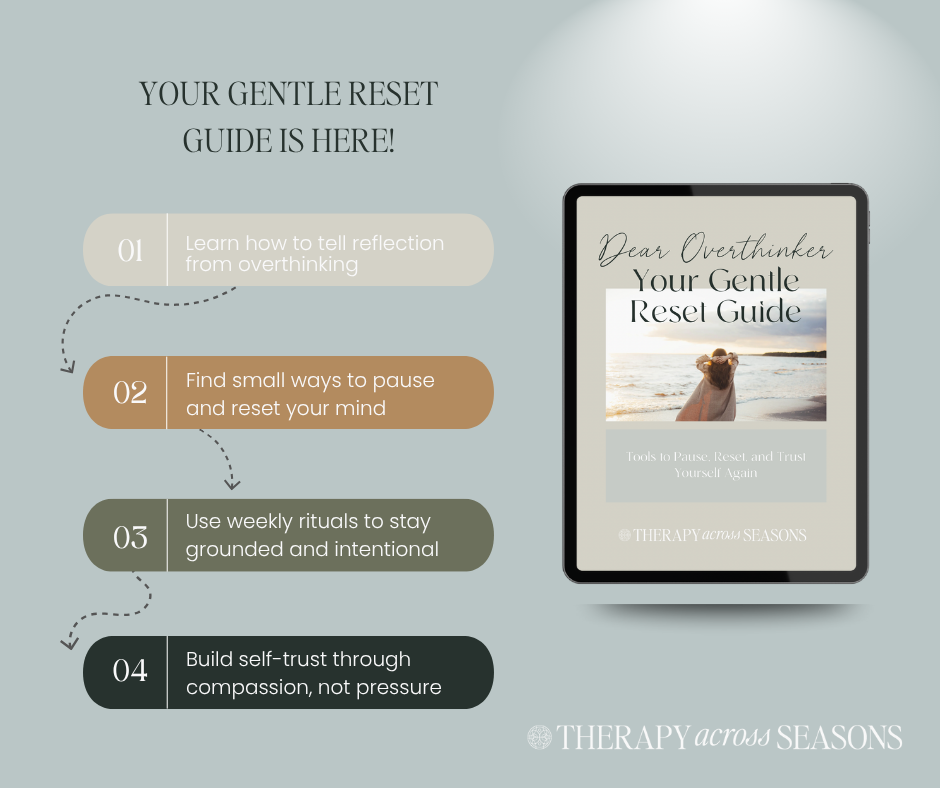
If this post resonated, my free guide, Dear Overthinker: Gentle Reset Guide, offers simple reflection prompts to pause, notice, and reconnect with yourself before you say yes out of guilt. It’s a small, kind way to start building inner safety; one “no” at a time. Download your free guide here →
`
Or, if you’re beginning to wonder what therapy might look like, you can book a free consult to see whether we’d be a good fit for your next season of growth.
Kindly,
Jennifer
This blog is for insight & education. It is not therapy.
This is a space for sharing reflective ideas, educational content, and general insights around therapy, culture, and relationships — not a substitute for professional mental health support, and it doesn't create a therapeutic relationship between us.
My hope is that what you read here gives you something to think about or helps you feel seen. But true therapeutic work happens in a space designed around you and your unique story — if you're ready for that kind of support, I encourage you to seek out a therapist who's a good fit. Any client experiences mentioned are composite examples drawn from common themes, never one real, identifiable person.
In crisis? Call or text 988 (Canada's Suicide Crisis Helpline, 24/7), or call 911 or go to your nearest emergency room.


